Our impact
Nutrition, jobs, and climate action — from one plant in Mzuzu.
EAP's integrated production model responds directly to Northern Malawi's everyday food, water, and fuel challenges with locally made, nutritionally superior products.
The challenge
Everyday realities for households across Mzuzu.
01
Limited access to consistently safe, affordable drinking water in many urban and peri-urban communities.
02
One of the highest childhood stunting rates in Sub-Saharan Africa, driven in large part by protein-deficient staple diets.
03
Very limited availability of affordable, shelf-stable dairy alternatives for households that cannot afford conventional milk.
04
A heavy household reliance on firewood and charcoal for cooking, which increases the time and labour burden on women and girls and contributes to deforestation.
Where we contribute
Three impact pillars.
Employment Creation
Dignified, formal jobs in food manufacturing and along the local soybean and maize supply chain, in a region with high youth unemployment.
Nutrition
Affordable, high-protein porridge flour and shelf-stable soy milk that help address childhood protein deficiency and stunting in Northern Malawi.
Environment & Climate
An all-electric processing approach, zero-waste soybean utilisation, and a fast-cooking porridge that reduces household firewood and charcoal use.
National & global goals
Aligned with Malawi 2063 and the SDGs.
Malawi 2063 — Agro-industrialisation
Transforming raw agricultural commodities into high-value, branded consumer products through modern local manufacturing.
Malawi 2063 — Food & Nutrition Security
Directly addressing Malawi's stunting and protein deficiency challenge with commercially sustainable, locally produced products.
National Water Policy
Expanding access to safe, affordable drinking water in Malawi.
SDG 2 — Zero Hunger
Affordable, high-protein food and shelf-stable soy milk contribute to improved food security and dietary diversity.
SDG 7 & 13 — Clean Energy & Climate Action
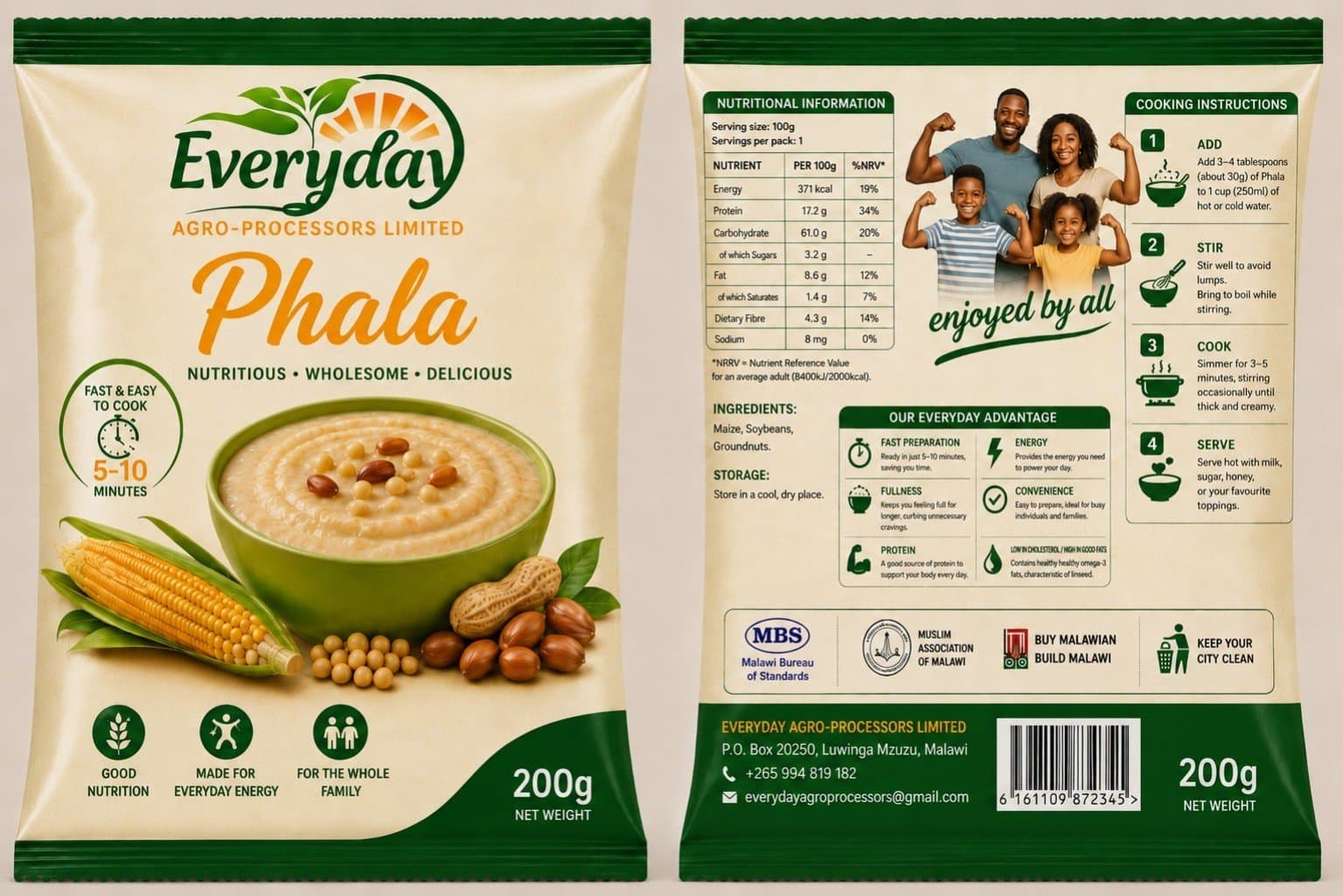
Everyday Phala's fast-cooking formulation reduces household firewood and charcoal use, cutting fuelwood demand and associated emissions.
SDG 8 — Decent Work
Creating formal, skilled employment in food manufacturing, a sector with strong multiplier effects in the local economy.
SDG 15 — Life on Land
Reduced household reliance on firewood and charcoal supports forest conservation in Northern Malawi.
Who we serve
From households to institutions.
Retail
Urban and peri-urban households seeking affordable, high-quality packaged food and water
Schools
School feeding programmes and school tuck shops
Health
Hospitals, clinics, and nutrition programmes
NGOs & Aid
Food security organisations and social protection programmes
Food Service
Restaurants, guesthouses, catering companies, and street food vendors
Looking ahead